Kubernetes Audit Integration
This integration allows you to observe and monitor:
- Creation and destruction of pods, services, deployments, daemon sets
- Creating/updating/removing config maps or secrets
- Attempts to subscribe to changes to any endpoint
and other operations performed on Kubernetes resources.
Setup methods
There are two alternative ways to set up this integration:
- Emulated audit logs (default): uses a Dynamic Admission Control to get notified whenever a resource change is submitted:
- It’s standard across all Kubernetes distributions, and easy to set up
- It doesn’t provide logs for Get/List/Watch operations
- It doesn’t provide IPs/User Agents
- Audit backend: relies on logs generated by the API server for any operation, as per the Audit Policy.
- It has the most complete visibility on all APIs, along with IPs and User Agents
- It officially needs to be set up to access the control plane, so set it up on managed when that access is not available, like in Managed distributions, is different on each use case, and logs can also have different formats.
- It is only available on Linux
Prerequisites
- Helm v3.8 or above
- Install Sysdig Shield on Kubernetes using Helm
Emulated audit logs method setup
Recommended: Replace
helm installwithhelm upgrade --install.To enable Kubernetes audit logging in your existing Sysdig Secure Helm install command, add the following flag:
--set features.detections.kubernetes_audit.enabled=trueFor On-Prem < 7.4, set the Sysdig Secure API token. The API Token needs to belong to a user with a Role containing the permission Policies | Runtime Policies =
READ.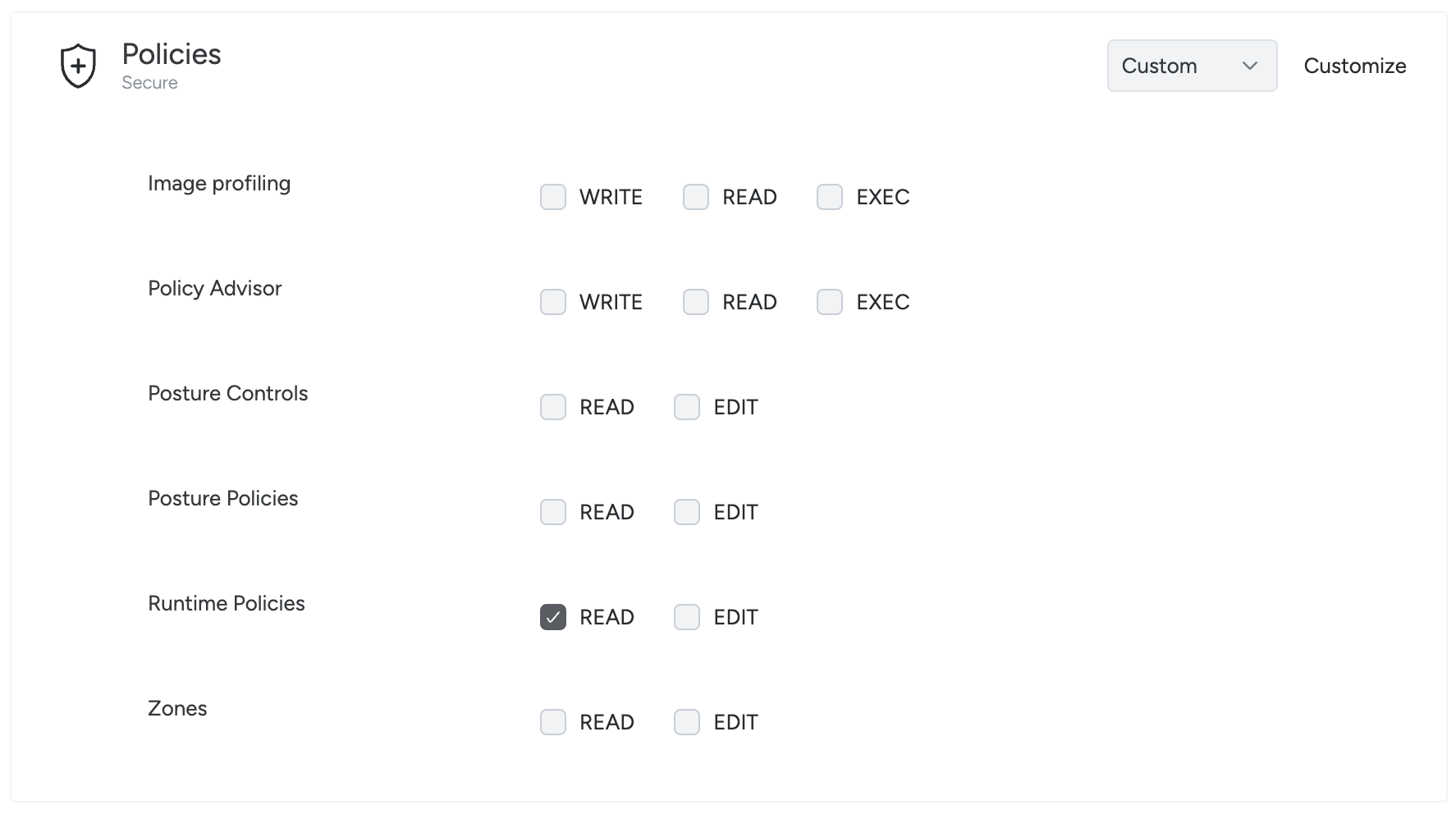
Set that in Helm as well:
--set sysdig_endpoint.secure_api_token="<YOUR_SYSDIG_API_TOKEN_HERE>"
For additional configuration options, refer to the installation guide and the configuration reference.
Audit backend method setup
This setup exposes a webhook through a Kubernetes Service, using the Shield chart. It then needs to be manually connected to the Kubernetes cluster audit log.
This setup heavily depends on Kubernetes distributions and their versions. We guide you through setting up the Service and only provide examples to connect this in some distributions.
For further support, please contact your Sysdig representative or Sysdig support.
Audit Log Webhook deployment
The following instructions apply to Cluster Shield 1.22 and above. Update it or refer to the legacy setup instructions.
Recommended: Replace
helm installwithhelm upgrade --install.To enable the Audit Log Webhook in your existing Shield chart Helm install command, add the following flags:
--set features.detections.kubernetes_audit.method=audit_backend
This will allow the Cluster Shield to receive Kubernetes Audit logs at http://sysdig-shield-cluster:6443/k8s_audit.
Kubernetes Audit Logs are defined in the audit.k8s.io/v1 API Group. Read more in the official Kubernetes documentation.
With Cluster Shield < 1.22
Recommended: Replace
helm installwithhelm upgrade --install.To enable the Audit Log Webhook in your existing Sysdig Secure Helm install command, add the following flags:
 --set host.additional_settings.security.k8s_audit_server_enabled=true
 --set host.additional_settings.security.k8s_audit_server_url=0.0.0.0
 --set host.additional_settings.security.k8s_audit_server_port=7765
Create a Service to expose it:
apiVersion: v1
kind: Service
metadata:
  name: sysdig-shield-audit
  namespace: sysdig
spec:
  type: ClusterIP
  ports:
    - port: 7765
      protocol: TCP
      name: audit
  selector:
    app.kubernetes.io/instance: shield
    app.kubernetes.io/name: shield
    sysdig/component: host
This will create a Webhook listening on 0.0.0.0:7765, which can be reached via http://sysdig-shield-audit.sysdig.svc.cluster.local:7765/k8s_audit.
Use this URL as the destination for the Audit logs instead of the one suggested, as it applies to setups using the new version.
Kubernetes Audit Logs are defined in the audit.k8s.io/v1 API Group. Read more in the official Kubernetes documentation.
Sending Audit Logs to the Webhook
This section provides examples of how to configure this in different Kubernetes distributions.
OpenShift
Starting from Logging 5.7, it’s possible to set up a ClusterLogForwarder to send Audit Logs to an HTTP backend.
It relies on a Service Account to operate, so:
- Start the creation with
kubectl create serviceaccount logging-sa -n sysdig - Bind it to the ClusterRole required
kubectl create clusterrolebinding logging-sa-binding \ --clusterrole=cluster-admin --serviceaccount=sysdig:logging-sa
Then, install the operator:
- Open the OpenShift Web Console.
- Navigate to Ecosystem -> Software Catalog
- Select
sysdigin the project list. - Search for “openshift logging” in the search bar.
- Install the Red Hat OpenShift Logging operator.
- Choose
sysdigas the Installed namespace. - Create a ClusterLogForwarder using the configuration below.
apiVersion: observability.openshift.io/v1
kind: ClusterLogForwarder
metadata:
  name: logging
  namespace: sysdig
spec:
  outputs:
    - name: cluster-shield-audit-webhook
      http:
        method: POST
        url: "http://sysdig-shield-cluster:6443/k8s_audit"
      type: http
  pipelines:
    - inputRefs:
        - audit
      name: audit-log-pipeline
      outputRefs:
        - cluster-shield-audit-webhook
  serviceAccount:
    name: logging-sa
Kops
To implement this in kops you need to edit the cluster configuration.
Start by obtaining the current cluster configuration and saving it to a file:
kops get cluster <your cluster name> -o yaml > cluster-current.yamlEdit
cluster-current.yaml, merging it with the YAML below, replacing what already exists and adding what’s missing. You can find the content of thewebhook-configandaudit-policyfile assets in the dedicated sections:- Audit Policy, to replace
AUDIT_POLICY_FILE_CONTENT - Webhook configuration, to replace
WEBHOOK_CONFIG_FILE_CONTENT.
spec: fileAssets: - name: webhook-config path: /var/lib/k8s_audit/webhook-config.yaml roles: [Master] content: | WEBHOOK_CONFIG_FILE_CONTENT - name: audit-policy path: /var/lib/k8s_audit/audit-policy.yaml roles: [Master] content: | AUDIT_POLICY_FILE_CONTENT kubeAPIServer: auditLogPath: /var/lib/k8s_audit/audit.log auditLogMaxBackups: 1 auditLogMaxAge: 10 auditLogMaxSize: 100 auditWebhookBatchMaxWait: 5s auditPolicyFile: /var/lib/k8s_audit/audit-policy.yaml auditWebhookConfigFile: /var/lib/k8s_audit/webhook-config.yaml- Audit Policy, to replace
Configure Kops with the new cluster configuration:
kops replace -f cluster.yamlUpdate the cluster configuration to prepare changes to the cluster:
kops update cluster <your cluster name> --yesPerform a rolling update to redeploy the master nodes with the new files and API server configuration:
kops rolling-update cluster --yes
GKE
GKE provides Kubernetes audit logs, but unlike standard Kubernetes, the logs are stored in Cloud Logging and use a different format than the native one used by Kubernetes. For more information, see Google’s official documentation.
To set up the audit log delivery infrastructure, you can use the command-line interface (CLI) or the Google Cloud Console. You can also provision the log delivery pipeline with Terraform.
As a preliminary step, enable audit log generation in your cluster.
- Run
gcloud container clusters update <CLUSTER_NAME> --logging=SYSTEM,WORKLOAD,API_SERVER. - See Google Cloud documentation for additional details.
- Open the Kubernetes Engine product page.
- Select the Clusters tab.
- Select your cluster.
- Select the Details tab.
- Find Logging in the Features section.
- Ensure at least Workloads and API Server are selected.
Additional information is available in the Google Cloud documentation.
Once these steps are completed, logs are available to be queried in Logs Explorer:
protoPayload.@type="type.googleapis.com/google.cloud.audit.AuditLog"
resource.labels.cluster_name="<CLUSTER_NAME>"
Next, enable Workload Identity in your cluster so Sysdig Shield can use a Google Cloud service account to access those logs.
- Set the workload pool on the cluster:
gcloud container clusters update <CLUSTER_NAME> \
  --region=<CLUSTER_REGION> \
  --workload-pool=<PROJECT_ID>.svc.id.goog \
  --project=<PROJECT_ID>
- List the node pools:
gcloud container node-pools list \
  --cluster=<CLUSTER_NAME> --region=<CLUSTER_REGION> --project=<PROJECT_ID>
- Enable Workload Identity on each node pool. For each result from the previous command, run:
gcloud container node-pools update <POOL_NAME> \
  --cluster=<CLUSTER_NAME> --region=<CLUSTER_REGION> \
  --workload-metadata=GKE_METADATA \
  --project=<PROJECT_ID>
From the Details tab on the Kubernetes Engine Clusters page:
- In the Security section, find Workload Identity and ensure it is enabled.
- Open the Nodes tab.
- For each pool in the Node pools list, select it.
- Ensure GKE Metadata Server is enabled.
Next, route those logs to Sysdig Shield through a delivery pipeline. Sysdig Shield consumes the logs from Pub/Sub using the StreamingPull API.
- Run
gcloud auth application-default login gcloud auth application-default set-quota-project <PROJECT_ID> - Save the following script to a
.tffile.# ── Configuration ──────────────────────────────────────────────────────────── # Fill in these values before running terraform apply. locals { project_id = "<PROJECT_ID>" # GCP project ID gke_cluster_name = "<CLUSTER_NAME>" # GKE cluster name (scopes the sink to one cluster; drop the cluster_name filter line below to capture all clusters in the project) shield_ksa_namespace = "sysdig" # K8s namespace cluster-shield runs in shield_ksa_name = "shield-cluster" # K8s ServiceAccount cluster-shield uses subscription_name = "<CLUSTER_NAME>-sysdigk8s-audit" # Pub/Sub subscription name; kube-detection probes this exact name at startup message_retention = "1800s" # Topic + subscription message retention (GCP minimum is 600s / 10 minutes) labels = { originator = "sysdig" } # Sink filter: K8s API-server audit logs only. Matches the audit-log proto # type and the k8s.io service so the topic isn't flooded with unrelated # Cloud Audit Log entries. ingestion_sink_filter = join(" AND ", [ "protoPayload.@type=\"type.googleapis.com/google.cloud.audit.AuditLog\"", "protoPayload.serviceName=\"k8s.io\"", "resource.type=\"k8s_cluster\"", "resource.labels.cluster_name=\"${local.gke_cluster_name}\"", ]) } # ───────────────────────────────────────────────────────────────────────────── terraform { required_version = ">= 1.5.0" required_providers { google = { source = "hashicorp/google" version = ">= 5.0" } random = { source = "hashicorp/random" version = ">= 3.0" } } } resource "random_id" "suffix" { byte_length = 4 } locals { name_prefix = "sysdig-gke-audit-${random_id.suffix.hex}" } # ── Pub/Sub topic ──────────────────────────────────────────────────────────── resource "google_pubsub_topic" "ingestion_topic" { name = "${local.name_prefix}-topic" project = local.project_id labels = local.labels message_retention_duration = local.message_retention } # ── Pub/Sub subscription ───────────────────────────────────────────────────── # # Consumed by cluster-shield's kube-detection via gRPC StreamingPull # (cloud.google.com/go/pubsub Subscription.Receive). No push endpoint — the # pod opens a long-lived bidirectional stream and the SDK handles ack-deadline # extensions, reconnects, and flow control internally. resource "google_pubsub_subscription" "ingestion_sub" { name = local.subscription_name topic = google_pubsub_topic.ingestion_topic.name project = local.project_id labels = local.labels ack_deadline_seconds = 60 message_retention_duration = local.message_retention # Never expire the subscription (matches --expiration-period=never). expiration_policy { ttl = "" } } # ── Cloud Logging sink ─────────────────────────────────────────────────────── resource "google_logging_project_sink" "audit_sink" { name = "${local.name_prefix}-sink" description = "Routes GKE K8s audit logs to Pub/Sub for cluster-shield kube-detection" project = local.project_id destination = "pubsub.googleapis.com/projects/${local.project_id}/topics/${google_pubsub_topic.ingestion_topic.name}" filter = local.ingestion_sink_filter unique_writer_identity = true } # ── IAM ────────────────────────────────────────────────────────────────────── # # Cluster-shield's KSA impersonates this GSA via Workload Identity. The GSA # needs two permissions on the subscription: # * pubsub.subscriptions.consume — granted by roles/pubsub.subscriber, used # by StreamingPull at runtime. # * pubsub.subscriptions.get — NOT granted by roles/pubsub.subscriber # despite the role name; required by the startup probe # (SubscriptionAdminClient.GetSubscription). Granted by roles/pubsub.viewer. resource "google_service_account" "kube_detection" { account_id = "sysdig-kube-det-${random_id.suffix.hex}" display_name = "Sysdig kube-detection audit reader" project = local.project_id } # Workload Identity binding: KSA <ns>/<name> may impersonate the GSA. # Requires Workload Identity to be enabled on the cluster and node pool. resource "google_service_account_iam_member" "kube_detection_workload_identity" { service_account_id = google_service_account.kube_detection.name role = "roles/iam.workloadIdentityUser" member = "serviceAccount:${local.project_id}.svc.id.goog[${local.shield_ksa_namespace}/${local.shield_ksa_name}]" } resource "google_pubsub_subscription_iam_member" "kube_detection_subscriber" { project = google_pubsub_subscription.ingestion_sub.project subscription = google_pubsub_subscription.ingestion_sub.name role = "roles/pubsub.subscriber" member = "serviceAccount:${google_service_account.kube_detection.email}" } resource "google_pubsub_subscription_iam_member" "kube_detection_viewer" { project = google_pubsub_subscription.ingestion_sub.project subscription = google_pubsub_subscription.ingestion_sub.name role = "roles/pubsub.viewer" member = "serviceAccount:${google_service_account.kube_detection.email}" } # Sink writer identity → ingestion topic publisher. resource "google_pubsub_topic_iam_member" "sink_publisher" { project = google_pubsub_topic.ingestion_topic.project topic = google_pubsub_topic.ingestion_topic.name role = "roles/pubsub.publisher" member = google_logging_project_sink.audit_sink.writer_identity } # ── Outputs ────────────────────────────────────────────────────────────────── output "pubsub_topic_name" { value = google_pubsub_topic.ingestion_topic.name } output "pubsub_subscription_name" { value = google_pubsub_subscription.ingestion_sub.name } output "sink_name" { value = google_logging_project_sink.audit_sink.name } output "kube_detection_service_account_email" { description = "Annotate the cluster-shield KSA with: iam.gke.io/gcp-service-account = <this value>" value = google_service_account.kube_detection.email } - In the script, set the Configuration values, or pass them as arguments (
-var variable=value). - Set up and apply the Terraform script:
terraform init terraform plan terraform apply - Collect the
pubsub_subscription_nameandkube_detection_service_account_emailoutputs; you need them to configure the integration later.
- Create a Pub/Sub topic.
gcloud pubsub topics create <TOPIC> \ --message-retention-duration=<RETENTION> \ --project=<PROJECT_ID> - Create a subscription.
gcloud pubsub subscriptions create <SUBSCRIPTION> \ --topic=<TOPIC> \ --ack-deadline=60 \ --message-retention-duration=<RETENTION> \ --expiration-period=never \ --project=<PROJECT_ID> - Create a logging sink to route logs to the Pub/Sub topic.
SINK_FILTER="protoPayload.@type=\"type.googleapis.com/google.cloud.audit.AuditLog\" AND protoPayload.serviceName=\"k8s.io\" AND resource.type=\"k8s_cluster\" AND resource.labels.cluster_name=\"<CLUSTER_NAME>\"" gcloud logging sinks create <SINK> \ pubsub.googleapis.com/projects/<PROJECT_ID>/topics/<TOPIC> \ --log-filter="$SINK_FILTER" \ --project=<PROJECT_ID> - Allow it to write to the topic.
SINK_WRITER=$(gcloud logging sinks describe <SINK> \ --project=<PROJECT_ID> --format='value(writerIdentity)') gcloud pubsub topics add-iam-policy-binding <TOPIC> \ --member="$SINK_WRITER" \ --role='roles/pubsub.publisher' \ --project=<PROJECT_ID> - Create a Service Account to access those logs.
gcloud iam service-accounts create <SYSDIG_SERVICE_ACCOUNT> \ --display-name='Sysdig kube-detection audit reader' \ --project=<PROJECT_ID> - Allow Sysdig Shield to use that Service Account.
gcloud iam service-accounts add-iam-policy-binding \ <SYSDIG_SERVICE_ACCOUNT>@<PROJECT_ID>.iam.gserviceaccount.com \ --role='roles/iam.workloadIdentityUser' \ --member="serviceAccount:<PROJECT_ID>.svc.id.goog[<KSA_NAMESPACE>/<KSA_NAME>]" \ --project=<PROJECT_ID> - Allow the Service Account to consume logs from the Pub/Sub subscription.
gcloud pubsub subscriptions add-iam-policy-binding <SUBSCRIPTION> \
  --member="serviceAccount:<SYSDIG_SERVICE_ACCOUNT>@<PROJECT_ID>.iam.gserviceaccount.com" \
  --role='roles/pubsub.subscriber' \
  --project=<PROJECT_ID>

gcloud pubsub subscriptions add-iam-policy-binding <SUBSCRIPTION> \
  --member="serviceAccount:<SYSDIG_SERVICE_ACCOUNT>@<PROJECT_ID>.iam.gserviceaccount.com" \
  --role='roles/pubsub.viewer' \
  --project=<PROJECT_ID>
- Open the Pub/Sub product page.
- Select Create topic.
- Disable Create a default subscription and proceed with the creation.
- Open it and, under Subscriptions, select Create subscription.
- Use a name of your preference and note it. You will need it later.
- Select Pull as the delivery type. We recommend setting the acknowledgement deadline to 60s and the expiration period to Never expire.
- On the Logging product page, select the Log Router feature and create a new sink.
- Set its destination to the Cloud Pub/Sub topic you just created.
- Set the inclusion filter to:
protoPayload.@type="type.googleapis.com/google.cloud.audit.AuditLog" AND protoPayload.serviceName="k8s.io" AND resource.type="k8s_cluster" AND resource.labels.cluster_name="<CLUSTER_NAME>" - From the created sink, open the details and copy the Writer Identity.
- Back on the Pub/Sub topic, in the right panel, open the Permissions tab, select Add principal, and give it the Pub/Sub Publisher role.
- Open the IAM & Admin product page and select the Service Accounts feature.
- Create a new Service Account to assign to Sysdig Shield for reading.
- Open it and, in the Principals with access tab, grant access to
<PROJECT_ID>.svc.id.goog[<SYSDIG_NAMESPACE>/<CLUSTER_SHIELD_SERVICE_ACCOUNT>]with the Workload Identity User role. Remember to replacePROJECT_ID,SYSDIG_NAMESPACE, andCLUSTER_SHIELD_SERVICE_ACCOUNTwith the actual values. - Go back to the Pub/Sub subscription you just created and, on the right panel, under the Permissions tab, select Add principal.
- Add the Service Account you just created and configure it with the Pub/Sub Subscriber and Pub/Sub Viewer roles.
After this is done, update the Helm configuration for Sysdig Shield:
 --set features.detections.kubernetes_audit.method=audit_backend
 --set features.detections.kubernetes_audit.gke_pub_sub_subscription=<SUBSCRIPTION>
 --set 'cluster.rbac.annotations.iam\.gke\.io/gcp-service-account=<SYSDIG_SERVICE_ACCOUNT>@<PROJECT_ID>.iam.gserviceaccount.com'
After applying the changes, restart deployment/shield-cluster to finalize the setup.
Note that Pub/Sub and Logging are paid GCP offerings.
GKE uses a Kubernetes audit policy that emits a more limited set of information than the one recommended by Sysdig. As a result, there are several limitations when retrieving Kubernetes audit information for the Events feed and Activity Audit features in Sysdig Secure.
Request Object
In particular, audit events for config maps in GKE generally do not contain a requestObject field that contains the object being created/modified.
Pod exec does not Include command/container
For many Kubernetes distributions, an audit event representing a
pod exec includes the command and specific container as arguments to
the requestURI. For example:
"requestURI": "/api/v1/namespaces/default/pods/nginx-deployment-7998647bdf-phvq7/exec?command=bash&container=nginx1&container=nginx1&stdin=true&stdout=true&tty=true
In GKE, the audit event is missing those request parameters.
Implications for the Event Feed
If the rule condition includes a field that is not available in the Kubernetes audit log provided by GKE, the rule will not trigger.
For example, rules targeting changes to ConfigMap content containing specific information or specific commands being executed will not trigger, leading to missed detections/false negatives.
This will also limit the information that can be displayed in the outputs of
rules. For example the command=%ka.uri.param[command] output variable
in the Attach/Exec Pod rule will always return N/A.
Implications for Activity Audit
kubectl execelements will not be scoped to the cluster name; they will only be visible scoping byentire infrastructure"A
kubectl execitem in Activity Audit will not display command or container informationDrilling down into a
kubectl execwill not provide the container activity as there is no information that allows Sysdig to correlate thekubectl execaction with an individual container.
EKS
The following instructions apply to Cluster Shield 1.23 and above. If you are running an earlier version, upgrade Cluster Shield to use this setup method.
Amazon EKS does not provide webhooks for audit logs, but it allows audit logs to be forwarded to CloudWatch. You can check the status and enable them via the Console or the AWS CLI.
- Open your cluster in EKS
- Select the Observability tab
- In the Control plane logs section, under “Audit”, you can verify its status
- If the status is “off”:
- Click “Manage” and ensure that “Audit” is selected
- Click “Save changes”
- Check that audit logging is enabled
aws eks describe-cluster \ --name <CLUSTER_NAME> --region <REGION> \ --query "cluster.logging.clusterLogging[?enabled==\`true\`].types" \ --output text - If the output doesn’t contain “audit”, enable it:
aws eks update-cluster-config \
--name <CLUSTER_NAME> --region <REGION> \
--logging '{"clusterLogging":[{"types":["audit"],"enabled":true}]}'
Next, you need to register the IAM OIDC provider for the cluster. First, obtain the cluster OIDC ID:
- From the cluster in EKS, open the Overview tab
- Scroll to the Details section
- Copy the OpenID Connect provider URL value, without the protocol part (
https://).
aws eks describe-cluster --name <CLUSTER_NAME> --region <REGION> \
  --query "cluster.identity.oidc.issuer" --output text
Copy the output without the protocol part (https://).
Then, verify whether the provider is already registered and configured correctly.
- Open the Identity providers feature of IAM Service
- Look for an entry whose Group name matches the OIDC ID you just obtained. If no entry is found:
- Click on “Add provider”
- Select “OpenID Connect” as the type
- Paste the OIDC ID in the Provider URL
- Set the Audience to
sts.amazonaws.com - Click on “Add provider”
aws iam list-open-id-connect-providers \
  --query "OpenIDConnectProviderList[?contains(Arn, '<OIDC_ID>')].Arn" \
  --output text
If the output is empty, you need to register the identity provider. If it is already present, skip ahead to the IAM Role provisioning.
To register it, use eksctl (simpler, safer, and quicker) or the AWS CLI.
eksctl (Recommended)
eksctl utils associate-iam-oidc-provider \
  --cluster <CLUSTER_NAME> --region <REGION> --approve
AWS CLI
THUMBPRINT=$(aws eks describe-cluster \
  --name <CLUSTER_NAME> --region <REGION> \
  --query "cluster.certificateAuthority.data" --output text \
  | base64 --decode | openssl x509 -fingerprint -sha1 -noout \
  | sed 's/://g; s/.*=//' | tr '[:upper:]' '[:lower:]')

aws iam create-open-id-connect-provider \
  --url https://oidc.eks.<REGION>.amazonaws.com/id/<OIDC_ID> \
  --client-id-list sts.amazonaws.com \
  --thumbprint-list "$THUMBPRINT"
Afterward, you need to provision an IAM Role that allows Sysdig Shield to access the audit logs. You can use either the Terraform snippet or the CloudFormation stack template below. To run either one, you will need:
- Cluster name
- Region (set as a value in Terraform; selected in the Console for CloudFormation)
- Cluster OIDC ID
- Sysdig Shield namespace
- Sysdig Cluster Shield service account name, if customized
- Cluster CloudWatch Log Group, if customized
Each produces an IAM Role whose ARN you will use later.
locals {
  # ── Required: fill these in ──────────────────────────────────────────────

  # AWS region where the EKS cluster lives.
  eks_audit_reader_region = "us-east-1"

  # Name of the EKS cluster.
  eks_audit_reader_cluster_name = "cluster-name"

  # OIDC issuer URL for the EKS cluster (no trailing slash).
  # Retrieve with:
  #   aws eks describe-cluster --name <cluster> --query 'cluster.identity.oidc.issuer' --output text
  eks_audit_reader_oidc_issuer_url = "https://oidc.eks.<region>.amazonaws.com/id/XXXXXXXXXXXXXXXXXXXXXXXXXXXXXXXX"

  # Kubernetes namespace and service account name for the Cluster Shield.
  eks_audit_reader_k8s_namespace       = "sysdig"
  eks_audit_reader_k8s_service_account = "shield-cluster"

  # ── Optional: override defaults ──────────────────────────────────────────

  # Override CloudWatch log group. Leave empty to use /aws/eks/<cluster>/cluster.
  eks_audit_reader_cw_log_group = ""

  eks_audit_reader_tags = {
    product = "sysdig-secure"
  }

  # ── Derived (do not edit) ─────────────────────────────────────────────────

  _eks_audit_reader_log_group_name = (
    local.eks_audit_reader_cw_log_group != ""
    ? local.eks_audit_reader_cw_log_group
    : "/aws/eks/${local.eks_audit_reader_cluster_name}/cluster"
  )

  # Strip the "https://" prefix to get the bare OIDC provider hostname used in
  # the IAM trust policy condition keys and OIDC provider ARN.
  _eks_audit_reader_oidc_provider = trimprefix(local.eks_audit_reader_oidc_issuer_url, "https://")

  _eks_audit_reader_oidc_provider_arn = "arn:${data.aws_partition.eks_audit_reader.partition}:iam::${data.aws_caller_identity.eks_audit_reader.account_id}:oidc-provider/${local._eks_audit_reader_oidc_provider}"

  _eks_audit_reader_log_group_arn = "arn:${data.aws_partition.eks_audit_reader.partition}:logs:${local.eks_audit_reader_region}:${data.aws_caller_identity.eks_audit_reader.account_id}:log-group:${local._eks_audit_reader_log_group_name}"
}

# ── Data sources ──────────────────────────────────────────────────────────────

data "aws_caller_identity" "eks_audit_reader" {}
data "aws_partition"       "eks_audit_reader" {}

# ── IAM role (IRSA) ───────────────────────────────────────────────────────────

resource "aws_iam_role" "eks_audit_reader" {
  name = "sysdig-eks-audit-reader-${local.eks_audit_reader_cluster_name}"
  tags = local.eks_audit_reader_tags

  assume_role_policy = jsonencode({
    Version = "2012-10-17"
    Statement = [{
      Effect = "Allow"
      Principal = {
        Federated = local._eks_audit_reader_oidc_provider_arn
      }
      Action = "sts:AssumeRoleWithWebIdentity"
      Condition = {
        StringEquals = {
          "${local._eks_audit_reader_oidc_provider}:sub" = "system:serviceaccount:${local.eks_audit_reader_k8s_namespace}:${local.eks_audit_reader_k8s_service_account}"
          "${local._eks_audit_reader_oidc_provider}:aud" = "sts.amazonaws.com"
        }
      }
    }]
  })
}

resource "aws_iam_role_policy" "eks_audit_reader" {
  name = "cloudwatch-read"
  role = aws_iam_role.eks_audit_reader.id

  policy = jsonencode({
    Version = "2012-10-17"
    Statement = [
      {
        # DescribeLogGroups does not support resource-level permissions.
        Sid      = "DescribeLogGroups"
        Effect   = "Allow"
        Action   = ["logs:DescribeLogGroups"]
        Resource = "*"
      },
      {
        Sid    = "ReadEksAuditLogs"
        Effect = "Allow"
        Action = [
          "logs:DescribeLogStreams",
          "logs:GetLogEvents",
          "logs:FilterLogEvents",
        ]
        Resource = [
          local._eks_audit_reader_log_group_arn,
          "${local._eks_audit_reader_log_group_arn}:log-stream:*",
        ]
      },
      {
        # Lets the Cluster Shield resolve the real cluster name from a node's
        # aws:eks:cluster-name EC2 tag, so the correct CloudWatch log group is
        # used even when it differs from the configured cluster name.
        # ec2:DescribeTags does not support resource-level permissions.
        Sid      = "ResolveClusterName"
        Effect   = "Allow"
        Action   = ["ec2:DescribeTags"]
        Resource = "*"
      },
    ]
  })
}

# ── Output ────────────────────────────────────────────────────────────────────

output "eks_audit_reader_role_arn" {
  description = "IAM role ARN. Set as the value of the eks.amazonaws.com/role-arn annotation on the Kubernetes service account."
  value       = aws_iam_role.eks_audit_reader.arn
}
AWSTemplateFormatVersion: "2010-09-09"
Description: >
  Provisions the identity to connect Sysdig Cluster Shield with EKS audit logs in CloudWatch Logs.

# ── Parameters ────────────────────────────────────────────────────────────────

Parameters:
  EksClusterName:
    Type: String
    Description: >
      Name of the EKS cluster. The CloudWatch log group
      /aws/eks/<EksClusterName>/cluster is used unless
      CloudWatchLogGroupName is set explicitly.

  OidcIssuerUrl:
    Type: String
    Description: >
      OIDC issuer URL for the EKS cluster (no trailing slash).
      Retrieve with:
      aws eks describe-cluster --name <cluster>
        --query 'cluster.identity.oidc.issuer' --output text

  K8sNamespace:
    Type: String
    Default: "sysdig"
    Description: >
      Kubernetes namespace for the Cluster Shield.

  K8sServiceAccount:
    Type: String
    Default: "shield-cluster"
    Description: >
      Kubernetes Service Account name for the Cluster Shield

  CloudWatchLogGroupName:
    Type: String
    Default: ""
    Description: >
      Override the CloudWatch log group name.
      Leave empty to use /aws/eks/<EksClusterName>/cluster.

# ── Conditions ────────────────────────────────────────────────────────────────

Conditions:
  UseDefaultLogGroup: !Equals [!Ref CloudWatchLogGroupName, ""]

# ── Resources ─────────────────────────────────────────────────────────────────

Resources:

  ReaderRole:
    Type: AWS::IAM::Role
    Properties:
      RoleName: !Sub "sysdig-eks-audit-reader-${EksClusterName}"
      Tags:
        - Key: product
          Value: sysdig-secure
      # Use Fn::Sub on a JSON string so the OIDC provider hostname can appear
      # as a map key inside the Condition block of the trust policy.
      AssumeRolePolicyDocument: !Sub
        - |
          {
            "Version": "2012-10-17",
            "Statement": [{
              "Effect": "Allow",
              "Principal": {
                "Federated": "arn:${AWS::Partition}:iam::${AWS::AccountId}:oidc-provider/${OidcProvider}"
              },
              "Action": "sts:AssumeRoleWithWebIdentity",
              "Condition": {
                "StringEquals": {
                  "${OidcProvider}:sub": "system:serviceaccount:${K8sNamespace}:${K8sServiceAccount}",
                  "${OidcProvider}:aud": "sts.amazonaws.com"
                }
              }
            }]
          }
        # Strip the "https://" prefix to get the bare hostname used in both
        # the OIDC provider ARN and the trust-policy condition keys.
        - OidcProvider: !Select [1, !Split ["https://", !Ref OidcIssuerUrl]]
      Policies:
        - PolicyName: cloudwatch-read
          PolicyDocument:
            Version: "2012-10-17"
            Statement:
              - # DescribeLogGroups does not support resource-level permissions.
                Sid: DescribeLogGroups
                Effect: Allow
                Action:
                  - logs:DescribeLogGroups
                Resource: "*"
              - Sid: ReadEksAuditLogs
                Effect: Allow
                Action:
                  - logs:DescribeLogStreams
                  - logs:GetLogEvents
                  - logs:FilterLogEvents
                Resource:
                  - !Sub
                    - "arn:${AWS::Partition}:logs:${AWS::Region}:${AWS::AccountId}:log-group:${LogGroup}"
                    - LogGroup: !If
                        - UseDefaultLogGroup
                        - !Sub "/aws/eks/${EksClusterName}/cluster"
                        - !Ref CloudWatchLogGroupName
                  - !Sub
                    - "arn:${AWS::Partition}:logs:${AWS::Region}:${AWS::AccountId}:log-group:${LogGroup}:log-stream:*"
                    - LogGroup: !If
                        - UseDefaultLogGroup
                        - !Sub "/aws/eks/${EksClusterName}/cluster"
                        - !Ref CloudWatchLogGroupName
              - # Lets the Cluster Shield resolve the real cluster name from a node's
                # aws:eks:cluster-name EC2 tag, so the correct CloudWatch log group is
                # used even when it differs from the configured cluster name.
                # ec2:DescribeTags does not support resource-level permissions.
                Sid: ResolveClusterName
                Effect: Allow
                Action:
                  - ec2:DescribeTags
                Resource: "*"

# ── Outputs ───────────────────────────────────────────────────────────────────

Outputs:
  RoleArn:
    Description: >
      IAM role ARN. Set as the value of the eks.amazonaws.com/role-arn
      annotation on the Kubernetes service account.
    Value: !GetAtt ReaderRole.Arn

  RoleName:
    Description: Name of the IAM role.
    Value: !Ref ReaderRole
Once you have the IAM Role ARN, update the Helm setup for the Sysdig Shield:
 --set features.detections.kubernetes_audit.method=audit_backend
 --set 'cluster.rbac.annotations.eks\.amazonaws\.com/role-arn=<IAM_ROLE_ARN>'
Once applied, restart deployment/shield-cluster to finalize the setup.
Please note that CloudWatch is an additional AWS paid offering. In addition, with this solution, all the pods running on the worker nodes will be allowed to read CloudWatch logs through AWS APIs.
AKS
In AKS, you can enable Audit Logs generation using Diagnostic Settings for the cluster. You can refer to the official documentation to set this up.
Those Diagnostic Settings will be used to route those logs to a destination which, unfortunately, can’t be the Sysdig webhook, directly. There are a few alternative architectures, but our suggestion is to employ Event Hub as a target.
If you choose this route, you will need something to subscribe to the Event Hub stream and send those events to the webhook. This can be achieved in many ways, among those:
- Use a Kubernetes deployment, like in the example available in this repository
- Use Logic App, triggering on events available on Event Hub and sending requests to the service, correctly exposed.
RKE/K3s
Audit support is already enabled by default, but the audit policy must be updated to provide additional granularity. These instructions enable a webhook backend pointing to the agent’s service.
The following steps need to be applied on each node in the control plane:
Follow the official documentation to edit the Audit policy. This is the link to v2.13; verify the exact procedure for your version. You can find a suggested Policy here.
Next, create the Webhook Configuration. Based on the distribution/version:
/var/lib/rancher/{rke2,k3s}/server/audit-webhook.yaml. You can find the content here, where you can use the pod network option.This configuration then needs to be used by the Cluster. This is applied via the control plane configuration (
/etc/rancher/rke2/config.yaml) or as arguments (SystemD approach)audit-policy-file=/var/lib/rancher/rke2/server/audit.yamlaudit-webhook-config-file=/var/lib/rancher/rke2/server/audit-webhook.yamlaudit-webhook-batch-max-size=100audit-webhook-batch-max-wait=5s
Finally, restart the nodes
IKS
IKS supports generating Audit Logs and forwarding them to an HTTP endpoint. The sole caveat is that the API server runs outside the cluster network and, therefore, needs to reach the webhook through its IP. The other limitation is on the generated logs, where the configured policy cannot be changed.
You can refer to IBM documentation to set this up. The Webhook URL can be obtained by looking at the Service previously set up"
echo "http://$(kubectl get service sysdig-shield-cluster -n sysdig -o jsonpath='{.spec.clusterIP}'):6443/k8s_audit"
Minikube
Minikube lets you manage the Control plane directly, so you can specify the Audit Policy and the Audit backend directly.
This is accomplished using the --extra-config parameter of the minikube start command, changing the apiserver configurations, as shown in the tutorial of Minikube.
See the reference for the minikube start command in the Minikube documentation and the apiserver configurations in the official Kubernetes documentation.
In each node of the Control plane, as suggested by the tutorial, create the audit-policy.yaml as well as the webhook-config.yaml files in the ~/.minikube/files/etc/ssl/certs directory. Afterward, you can restart Minikube by specifying the following options:
--extra-config=apiserver.audit-policy-file=/etc/ssl/certs/audit-policy.yaml--extra-config=apiserver.audit-log-path=---extra-config=apiserver.audit-webhook-config-file=/etc/ssl/certs/webhook-config.yaml--extra-config=apiserver.audit-webhook-batch-max-size=10--extra-config=apiserver.audit-webhook-batch-max-wait=5s
Kubeadm
With Kubeadm you manage the Control Plane directly so you can create the audit-policy.yaml and the webhook-config.yaml files in the /etc/kubernetes/ folder.
Then, make the Control plane use them. Create /etc/kubernetes/kubeadm-audit-config.yaml with:
apiVersion: kubeadm.k8s.io/v1beta4
kind: ClusterConfiguration
kubernetesVersion: v1.16.0
apiServer:
  extraArgs:
    - name: "audit-policy-file"
      value: "/etc/kubernetes/audit-policy.yaml"
    - name: "audit-log-path"
      value: "-"
    - name: "audit-webhook-config-file"
      value: "/etc/kubernetes/webhook-config.yaml"
    - name: "audit-webhook-batch-max-size"
      value: "10"
    - name: "audit-webhook-batch-max-wait"
      value: "5s"
Finally, run kubeadm init --config /etc/kubernetes/kubeadm-audit-config.yaml
See the official documentation for additional information.
Reference: Audit Policy
This is a general-purpose Audit Policy you can use to audit all the relevant events in the Control Plane. Adjust it based on your use case, if needed.
apiVersion: audit.k8s.io/v1
kind: Policy
omitStages:
  - "RequestReceived"

rules:
  # Ignore low-impact read-only URLs
  - level: None
    userGroups: ["system:authenticated"]
    nonResourceURLs:
      - "/api*"
      - "/version"
      - "/healthz"
      - "/readyz"
      - "/livez"

  # Ignore system noise
  - level: None
    users:
      - "system:kube-proxy"
      - "system:kube-scheduler"
      - "system:kube-controller-manager"
    verbs: ["get", "list", "watch"]

  # Log exec, attach, port-forward at RequestResponse (capture commands)
  - level: RequestResponse
    verbs: ["create"]
    resources:
      - group: ""
        resources: ["pods/exec", "pods/attach", "pods/portforward"]

  # Log security-sensitive resources at RequestResponse level
  - level: RequestResponse
    resources:
      - group: ""
        resources: ["secrets", "serviceaccounts"]
      - group: "rbac.authorization.k8s.io"
        resources:
          ["roles", "rolebindings", "clusterroles", "clusterrolebindings"]
      - group: "networking.k8s.io"
        resources: ["networkpolicies"]
      - group: "policy"
        resources: ["podsecuritypolicies"]

  # Log pod and deployment changes at RequestResponse
  - level: RequestResponse
    resources:
      - group: ""
        resources:
          ["pods", "services", "persistentvolumes", "persistentvolumeclaims"]
      - group: "apps"
        resources: ["deployments", "daemonsets", "statefulsets", "replicasets"]

  # Log configmap changes
  - level: Request
    resources:
      - group: ""
        resources: ["configmaps"]

  # Catch-all at Metadata level
  - level: Metadata
    omitStages:
      - "RequestReceived"
Reference: Webhook configuration
This is a standard configuration for the audit webhook. Based on the networking your Control Plane uses, you should set AUDIT_WEBHOOK_ENDPOINT differently:
sysdig-shield-clusterif it uses the pod networking and can access the Cluster DNS- The ClusterIP corresponding to the Service, if it runs outside the pod networking. This can be obtained via:
kubectl get service sysdig-shield-cluster -n sysdig -o jsonpath='{.spec.clusterIP}')
apiVersion: v1
kind: Config
clusters:
  - name: sysdig
    cluster:
      server: http://AUDIT_WEBHOOK_ENDPOINT:6443/k8s_audit
    users:
      - name: sysdig
    contexts:
      - context:
          cluster: sysdig
          user: sysdig
        name: sysdig
    current-context: sysdig
Next Steps
Once this is set up, you will see:
- Events in the Events Feed, if you enabled Kubernetes Audit Threat detection policies and any Audit log matches the rules they contain.
- Activity Audit entries for the Kubernetes Data source (
attach/exec).
